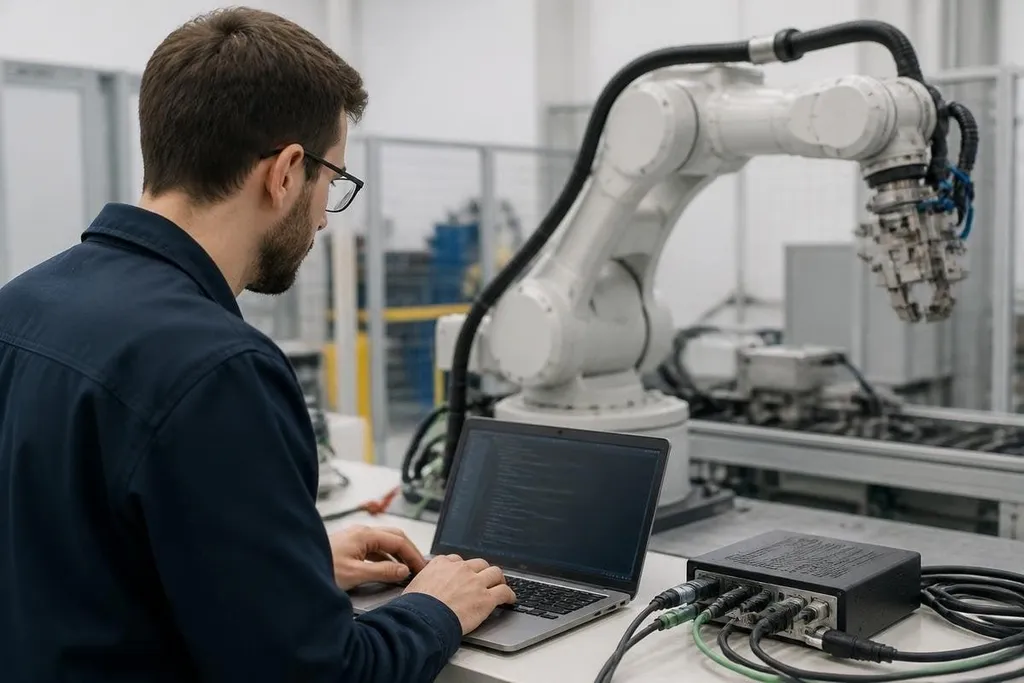
A robot can be hacked through its network, update service, camera, controller, or maintenance laptop. Security standards will need to cover that full chain, because a flaw in one part can change what the machine does in the physical world.
Quick read
- Robot security must cover software, hardware, people, and suppliers.
- Safe updates need identity checks, clear logs, and a way to recover.
- Buyers should ask what happens when a robot loses its network connection.
A robot is a physical security problem
A stolen file is serious. A changed robot movement can damage stock, equipment, or a person. That difference means robot security needs more than a password rule or a firewall around the factory network.
The machine needs controls that connect cyber events to physical action. A remote command might start a motor, change a route, alter a gripper setting, or disable a safety limit. A useful standard should require the system to record who sent that command, what changed, and whether the robot accepted it.
This also changes how teams test security. They need to check the robot at rest, during a task, while charging, and during maintenance. A test that checks only the cloud connection leaves the controller and local tools out of view.
The whole supply chain needs a rule
Robot makers rarely build every part themselves. A system may include cameras, motor drives, navigation software, wireless modules, cloud services, and tools from outside suppliers. Each part can carry software that needs updates or access to machine data.
A future standard should ask for a clear software and hardware record. The buyer needs to know which parts are inside the robot, who supports them, and how long security fixes will be available. Without that information, a machine can remain in service after its software support ends.
The same rule should apply to service access. A technician may need a remote connection to diagnose a fault, but that connection should have a named account, a time limit, and a record of the work. Shared passwords make later checks much harder.
A software update can change how a robot moves, stores data, or accepts commands, so security rules need the version, release date, and rollback plan recorded. Robot 24 can put those details beside reports of real machines, giving buyers a way to check whether an update protects the task or creates a new risk.
Updates must protect the task
Software updates fix defects, but an update can change timing, motion, sensor handling, or network behavior. A robot that worked before the update may need a new safety check before it returns to production.
Standards should set a minimum process for updates. The maker should sign the software, the robot should verify that signature, and the system should keep the last known working version when a new update fails. The update record should show the version, time, account, and result.
That process matters most for robots that work away from a desk. A warehouse robot may lose its network link during an update. A field robot may have limited access to a service team. The machine needs a safe state and a recovery method that do not depend on a live connection.
What buyers should ask for
Security language in a sales document is not enough. Ask for evidence that matches the robot, its controls, and the way your team will run it.
Use this checklist before signing a purchase order:
- Map access: list every local, remote, cloud, and maintenance account.
- Check updates: ask how software is signed, verified, reversed, and supported.
- Review logs: confirm that command changes and service sessions are recorded.
- Test isolation: see what the robot can do after its network connection is cut.
- Set ownership: name the team that receives alerts and fixes security faults.
- Plan retirement: define how accounts, certificates, data, and stored keys are removed.
These questions turn security from a promise into a condition that a supplier can show. They also give the operations team a way to check the robot after installation, instead of trusting a document written before the machine reached the site.
The standard should match the risk
A small research arm and an autonomous mobile robot do not face the same hazards. One may sit behind a guard in a lab; the other can move through shared spaces while carrying a load. A single checklist for every robot would miss that difference.
I’d require every security standard to link its controls to the robot’s tasks and failure states. The open question is whether makers, buyers, and safety bodies can agree on that risk record before connected robots become too varied for one common method.